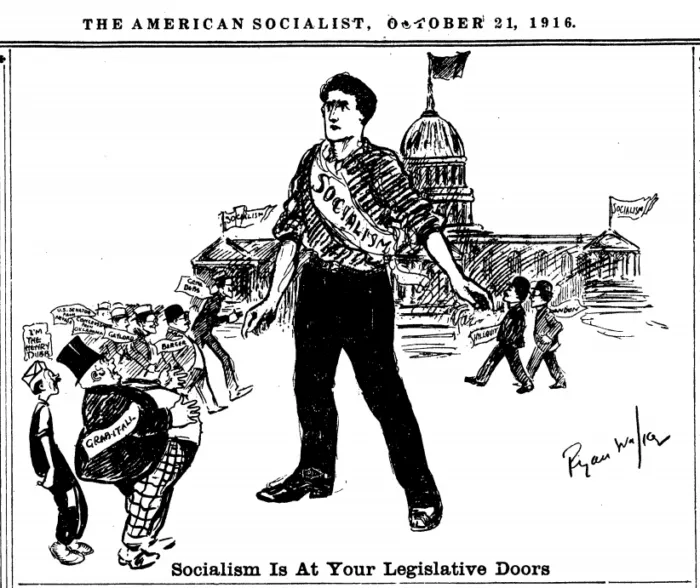
Comrade Steven examines the history of Socialists elected to Congress in the twentieth century to draw lessons for DSA’s 2026 Congressional campaigns.
Read the Printable version here
Steven R
[caption id="" align="alignnone" width="700"]
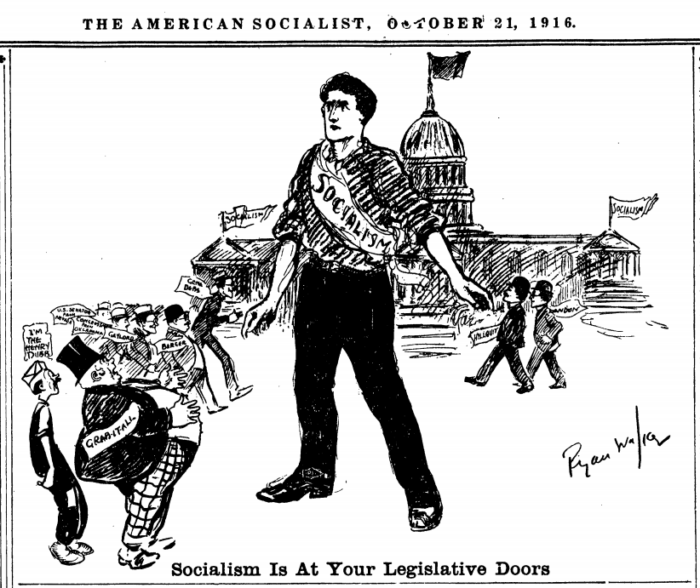
Ryan Walker, Socialism is at your legislative doors [/caption]
At the time of writing, as many as ten Democratic Socialists of America members may seek national endorsement for Congressional races in this year's midterms. Winning even half of these races would qualify 2026 as the most successful year yet for our national electoral project. At the same time, with DSA's relationship to our Congressional representatives historically confused and contentious, it would present the socialist movement with new uncertainties for the second half of the Trump administration and beyond.
Socialists should take a leap of faith and use 2026 to build something bigger than the careers of any of our individual candidates or electeds. Now is the time to carve out space for a kind of politics that has become alien to the American electorate: a revolutionary, party-building approach to elections. We can learn from how our sister party of a hundred years ago, the Socialist Party of America (SPA), used Congress to strengthen its organization during the period it was a mass party that anchored the socialist Left in the United States.
Representing a Mass Socialist Party
From 1910 to 1920, the Socialist Party elected two of its members to the House of Representatives, and credibly contested numerous other Congressional seats. Socialist candidates for Congress were the standard-bearers of a party-movement that was beginning to blossom into a genuine mass force in American society. They helped popularize the Socialist message to millions of voters, as well as onlookers who, like most American workers at the time, could not vote.
The party project these Socialist candidates and Congressmen worked to build was eventually destroyed by government repression and internal strife that disrupted the party's democracy. But for years, it survived and even thrived in the face of intense opposition and reached heights that the modern DSA should envy.
Socialist campaigns for the House looked different in the 1910s than they do today. For one, the socialist movement had its own ballot line, whereas DSA generally runs candidates in Democratic primaries. The different degree of control over who runs (and how) is also notable. The SPA's congressional races bore more similarities to how many DSA chapters today relate to local races than they do runs for Congress. The party, not the prospective candidates, decided who to run and on what platform. There was no possibility that a member could run without the party's endorsement, and there was no ambiguity that the SPA was its candidates' political home, not just one among many in a coalition of endorsers.
I offer a disclaimer that his article will reference the career of Victor Berger, the Socialist Congressman from Milwaukee. No serious study of the SPA should do so without mentioning Berger's record of white supremacism. Like many figures in the history of our movement, we should look to this history without illusions. Part of the strength of the SPA's electoral program in its heyday was that its electeds represented the mandates of the party membership, not their own personal political projects. In that respect Berger was a vessel for a political strategy that is worth adapting to our modern conditions.
Lesson 1: Fight the Battle to Win the War
The Socialist Party ran members for Congress fully intending to elect them to office. But this was not their only goal. Socialist candidates used their campaigns to grow and strengthen the party by relentlessly campaigning on its platform and running on a slate with fellow Socialists. Socialists campaigned together, and party literature encouraged voters to support a straight Socialist ticket.
This strategy was well-suited to the Socialists' independent ballot line, but is in line with the orientation DSA adopted at the 2025 National Convention which argues that political independence can be pursued on any ballot line. It will become especially important if DSA’s roster of congressional candidates runs under different party labels. With Chicago DSA endorsing Byron Sigcho-Lopez for the House as an independent, for example, building a common party identity with those DSA candidates contesting Democratic primaries will require an active effort to associate candidates with the Democratic Socialist label and program, and not with the ballot line their name might appear on.
Chapters considering Congressional endorsements should require that nominees cross-endorse other DSA candidates and only other DSA candidates, including other national endorsees for Congress and DSA members running for state and local office in their districts. They should also stipulate that an endorsement requires candidates to promote DSA on their website, in campaign literature, at campaign events, and in earned media, and to publicly endorse DSA's national program, Workers Deserve More.
Lesson 2: Know Your Audience
When they won their campaigns, Socialists used their seats in Congress as a platform to speak to the working class, not a place to bargain with other Congresspeople. Berger said as much during his first term in the House: “I shall prepare my speeches very carefully…because I feel that I am not talking to that crowd up there [in Congress], but, as they say in Germany, ‘out of the window, to the people at large.’”
Socialists treated the floor of the House as the biggest campaign platform in the nation, and used every opportunity to speak before the body while actually addressing the masses outside the chamber's walls. Their speeches were tailored to the needs of mass propaganda and printed widely in the Socialist press. During the Wilson administration's "preparedness" rush before the First World War, Socialist Congressman Meyer London from New York took the floor to propagandize against the coming war, knowing full well he would be overwhelmingly voted down. London exposed the class interests behind the war and offered his colleagues a choice: take action to secure a fast peace or face "one of the greatest revolutions in the history of mankind." The real message was aimed at the working class: force your masters to concede peace or give them class war.
Chapters who manage to elect members to Congress should work closely with them through Socialists in Office (SIO) committees to coordinate their interventions in Congressional debate, co-author and edit their speeches, and turn their remarks on the floor into propaganda to be publicized through every available medium.
Lesson 3: Raise Expectations
If DSA elects a strong bloc to Congress in 2026, we will have to make a decision about our theory of change: do we contest legislative offices to negotiate for incremental reforms within a larger liberal coalition, or is the point to stake out a distinct socialist position in American politics and expand the horizons of our movement?
The Socialist Representatives did campaign for constructive legislation, like Meyer London's bill to introduce social insurance. But their overall strategy, as a party outnumbered 434-to-one in the House, hinged on their ability to raise the expectations of the class. They used Congress as a tool to organize workers to fight for demands that the capitalist parties would never give up in backroom negotiations.
When he was first elected to Congress, Victor Berger introduced a slate of legislation which included resolutions to abolish the Senate and call a new Constitutional convention. This had no chance of passing, but it earned publicity for demands the party would campaign on in its 1912 races. On pieces of legislation like his bill to introduce pensions for the elderly, Berger appended a controversial clause declaring that it was not subject to judicial review. This was in hopes of provoking a confrontation with the Supreme Court which might strike down the broadly popular demand.
The strategy of using Congress to stump for the Socialist program did not mean substituting words for action. Socialists used Capitol Hill as an organizing tool, not just a propaganda tool. In the leadup to the American entry into the First World War, Congressman London exploited a committee hearing to bring the SPA and the labor movement directly onto the House floor. Throngs of working-class observers watched on as socialists and trade-unionists testified against the capitalist conspiracy to send workers off to die for profit. Their remarks, of course, were reprinted in the red press for the benefit of the many workers who could not physically come to Washington to hear them.
This approach also did not forego real, tangible victories for the sake of the moral victory of saying the right things at the right time. Berger’s indictments of the ruling class helped workers win the Lawrence textile strike in 1912 and forced a corrupt federal judge who had targeted Socialists for denaturalization to resign in disgrace. London's rabble-rousing killed a provision of the 1917 Jones Act that would have imposed Jim Crow literacy and property requirements on suffrage in Puerto Rico, saving tens of thousands of working-class Puerto Ricans from further disenfranchisement under American occupation.
If the Democrats retake one or both chambers of Congress in 2026, an enlarged DSA bloc in the House could emulate the SPA's Congressional tribunes by proposing legislation that, although unlikely to pass, would raise voters' expectations of what the "opposition party" can achieve. A floor vote on a DSA-submitted bill to abolish ICE or to zero-out the budget for Trump's war agenda abroad in order to restore programs like SNAP at home would be immensely clarifying for DSA's potential base ahead of the 2028 elections. Socialist members of Congress could lead the charge on filing for Trump's impeachment on charges mainstream Democrats would normally avoid, turning the hearings into a public trial on Trump's criminal warmongering and forcing Democrats to publicly choose between the sympathies of their own voters and military-industrial complex donors.
DSA's representatives could also borrow from the SPA's playbook by fighting to attach "not subject to judicial review" clauses to popular legislation like, for example, a bill to legalize abortion nationwide in the wake of the Dobbs decision. Such a stunt would put the undemocratic nature of the judiciary center stage in the struggle for social freedoms. It would also delineate DSA, the party of consistent democracy, from the Democrats, the party of subservience to Trump's reactionary unelected Supreme Court.
Regardless of which bloc of capitalists controls Congress next year, DSA's legislators should invite the working class to crash the party. Like Meyer London, a DSA bloc could use committee hearings to give DSA partisans and union militants the Congressional megaphone. Even under a maximally restrictive Republican majority, they could act as organizer-legislators and use the prestige of their office to push the boundaries of collective action outside Congress. NYC-DSA electeds’ direct participation in street protests and civil disobedience against the genocide in Gaza offers some recent inspiration.
Lesson 4: Give No Quarter
At its best, the Socialist Party's activity in Congress embodied the role of an unrelenting opposition. Its electeds knew this would mark them for repression by the ruling capitalist parties and acted accordingly. They expected no quarter from their major party colleagues and gave none in return. When their efforts to use Congress to propagandize for the socialist program were inevitably met with attempts to shut them out, they fought back with every tool at their disposal to disrupt the functioning of the capitalist state and draw clear battle-lines for the whole working class to see.
During the SPA's campaign against war mobilization in 1916, Meyer London spared no opportunity to rise and speak against the Wilson administration's maneuvers towards joining the war, including during floor debate on bills where it was not strictly relevant. On at least one such occasion, the Speaker of the House put London under a gag order (a time-honored Democratic tradition since the days of silencing abolitionists), at which point the Socialist Congressman used procedural rules-lawyering to stall proceedings. He then ordered a roll call in an attempt to disperse the body for lack of quorum. London knew he did not have the votes to overturn a gag order; the point was to be seen fighting to the last resort for his right to make a pro-peace stand in Congress and to punish the capitalist majority for suppressing him by turning every effort to do so into a fiasco.
DSA legislators could stand to learn from this kind of intransigence, which is also modeled in the modern day by left-wing parties like the Economic Freedom Fighters in the South African parliament. The logic is simple: as a socialist deputy, no matter how much you might prefer to negotiate in good faith, the billionaires' paid representatives see you as an enemy to be marginalized. So turn Congress upside down and see what falls out. Socialist representatives should do everything in their power to disrupt any Congressional business that does not benefit the working class or advance the socialist program.
A small but disciplined bloc of socialists could be a real obstacle to the ruling-class parties' ability to govern without objections from or concessions to the working class. This is especially true with the razor-thin legislative majorities that have become the norm in this era of protracted crisis. Borrowing a tactic from historical abolitionists and modern reactionaries, a bloc of DSA representatives could hold Speaker of the House elections hostage for a set of incisive popular demands and use the repeated nominating motions for a Speaker candidate of their own as free airtime for agitational speeches. By the same principle, they could hold up budget negotiations or extensions of the debt ceiling by refusing to vote for a dime for the military, ICE, or Israel.
Even in scenarios where a Republican majority (or Democrats' willingness to cross the aisle to create one) dilutes the structural leverage of a Socialist bloc in the legislature, our representatives could creatively abuse their powers to make it difficult to conduct legislative business. They could, for instance, exploit their ability to issue gallery passes to pack the chamber with hecklers, and then act as hecklers themselves if their guests are dragged out and their gallery passes voided.
It is plausible that a DSA bloc going out of its way to disrupt the proceedings of a reactionary Congress would at some point see one or more of its members expelled from the body. The precedent for this was set when Representatives on both sides of the aisle voted to censure Rashida Tlaib for speaking in favor of Palestinian liberation. Here, too, socialists should give no quarter and accept no setback as a defeat.
When Victor Berger was sentenced to 20 years in prison for opposition to the First World War shortly before swearing in for his second term in Congress, the House voted to vacate his duly-elected seat. Rather than surrender the district or run a less encumbered candidate, the Socialists successfully re-elected Berger in the special election to replace himself. He was disqualified a second time, but the Socialists continued re-running him until he was at last allowed to take his seat after his third re-election in 1922. A similar drama played out in 1919 at the state level in New York, where the Socialists turned the ejection of five of their members from the State Assembly into a cause célèbre for organized labor and successfully neutralized their expulsion by winning re-election in 1920.
In a historical moment like this, the working class needs fighters. DSA should put the acquiescent Democrats to shame by electing socialists who will show the people what it really looks like to fight the agenda of the reactionary, anti-democratic ultra-rich.
Lesson 5: Serve Something Greater
The Socialist Party's electoral machine was far from perfect. Alongside inspiring examples of what it means to send a socialist rebel into the halls of power, it also suffered shortcomings we in DSA would find familiar today. While Meyer London took a heroic stand for the Socialist Party's anti-war program in Congress during the "preparedness" rush of 1915-1916, when the US officially entered the war in 1917, his resolve wavered amidst high-profile defections from the party. He ultimately broke in support of the war in the name of “national defense,” which elicited a major scandal in the party. This breach of programmatic unity with the comrades to whom he owed his office prepared the ground for the split that marked the end of the SPA’s existence as a mass party in 1919.
We see echoes of London's defection today in Jamaal Bowman and AOC's support for Israeli military funding and in Zohran Mamdani's scabbing on NYC-DSA's electoral program to clear the field for a liberal Zionist. Especially as the Trump administration escalates warmongering across Latin America, in the Middle East, and towards China, the specter of the kind of wartime emergency that confronted the SPA in 1917 rises again. It is imperative that DSA build the capacity to articulate the democratically decided politics of our membership through our representatives in Congress. They must not merely tail behind or react against political decisions made behind closed doors under the opportunist pressures of their offices.
Where possible, DSA chapters should run dedicated, active members for Congress with clear expectations set ahead of time. Endorsees should be bound to promote and abide by DSA's program, caucus together and vote as a bloc, refuse to cross the class line for perceived short-term gains, and consult with the National Political Committee or their chapter SIO structures on certain pre-defined categories of decisions. Members should take the initiative by writing resolutions to craft sample legislation based on DSA's program for our tribunes in Congress to bring to the floor. In order to expand the country's political horizons and advance the socialist agenda, we should all be ready to fight for candidates and electeds who rise to this challenge and take the leap of faith with us.
The crisis we are now living through has no clear precedent in American history. The working class is fighting for its very survival in the face of climate catastrophe, the threat of war, and the repressive rampages of a tyrannical administration empowered by an undemocratic and decaying constitutional order. In times like these, workers deserve more from the elected representatives of our movement. We need a fundamentally new—but not historically unprecedented—kind of politics to survive the crisis and conquer power.